



Floor 03 · Grow
SEO and GEO services. One plan for both kinds of search.
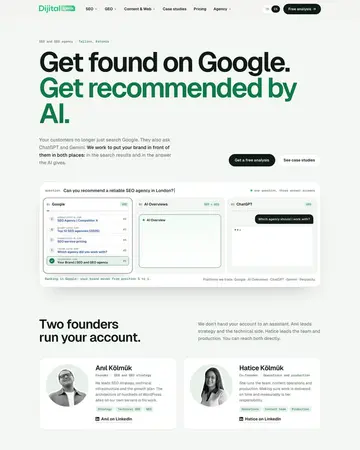
SEO earns your pages a place in Google’s results. GEO, short for generative engine optimization, earns your company a mention when someone asks ChatGPT, Gemini or Perplexity instead. Both reward the same groundwork: pages that answer the question straight away, a site that loads and crawls cleanly, and company facts that match wherever they appear. On the Grow floor yop runs the two as one project with one monthly report.
On this floor
Seven services, one set of foundations.
- your-brand.com
Search and AI answers
Technical fixes, content and links that lift you on Google.
Your name in the answers ChatGPT, Gemini and Perplexity give.
Crawling, indexing and speed fixed at the source.
What holds your site back, ranked by what it costs you.
Found on the map when people search nearby.
Categories and products that rank and sell.
How often AI assistants name you, measured every month.
SEO and GEO
Same groundwork, two places to be found.
SEO is measured in a list of links; GEO is measured inside a written answer. The work underneath is mostly the same, which is why we never split it.

| How SEO and GEO differ, and what they share | SEO | GEO |
|---|---|---|
| Where you show up | Google and Bing results pages | Answers from ChatGPT, Gemini, Perplexity and AI Overviews |
| What it rewards | Relevant pages, links, speed and clean code | Direct answers, facts with a source, one consistent company profile |
| How it is measured | Rankings, clicks and inquiries | Mentions and citations inside AI answers |
| Usual first step | A technical audit of the site | A check of what assistants say about you today |
Try it
Where SEO stops and GEO starts.
Nine jobs we do for search, sorted by who they help: Google’s results, the AI assistants, or both. Most jobs end up in the middle lane.
- 01Pages crawlers can reach
- 02Fast on a phone
- 03One keyword per page
- 04Links from trusted sites
- 05The answer in the first lines
- 06Schema markup
- 07The same facts on every profile
- 08Mentions on sites assistants cite
- 09Buyer questions run in assistants
Nine jobs on the table, in no order yet.
Which one do I need?
Start from where you are missing.
Your pages sit on page two or three of Google for the terms that sell.
Technical fixes first, then pages rewritten around one keyword each.
Assistants name your competitors when buyers ask, and leave you out.
Answer-first pages, cited facts and the same story on every profile.
Your site is slow, or half of it never made it into the index.
Speed, crawl and indexing come before any new content.
Half your buyers search in a language your site does not speak yet.
A keyword map and a page structure for each market, on the Go global floor.
Glossary
Search and AI, in plain words.
The words that come up in every SEO and GEO report, explained once, so the monthly numbers read easily.

- AAI Overview
- The summary Google writes above its results for some searches, with links to the pages it drew on.
- CCitation
- A link that an AI answer displays as its source. A citation can send a visitor; a mention only names you.
- EEntity
- Something search engines know as one item, such as your company, with facts attached: name, place, services, people.
- SSchema markup
- Code that labels the facts on a page for machines, such as opening hours, prices or who wrote an article.
- SSERP
- Search engine results page: everything Google or Bing shows for a query, including ads, maps and AI Overviews.
- SShare of voice
- How often your brand turns up across a fixed set of searches or AI questions, next to your competitors.
How it runs
One audit, one monthly report.
Audit
We crawl the site, time it on a phone, list the pages Google left out and ask the assistants who they would recommend.
Map
The searches and the questions your buyers type, with one focus keyword for each page.
Fix and write
Technical errors first, then pages rewritten answer-first and marked up with schema.
Align
Company name, services and facts made identical on the site and on the profiles that mention you.
Report
Rankings, traffic and AI mentions side by side, every month.
Common advice
Three ideas that cost companies time.
Each one sounds reasonable and sends the budget the wrong way. Here is what we see instead.
We often hear
“GEO is a trick to get into ChatGPT.”
What we see
There is no switch to flip. Assistants repeat what is clear, sourced and confirmed by other sites. GEO is the steady work of becoming that source.
We often hear
“An llms.txt file will do it.”
What we see
It is an optional file, still only a proposal, that lists your key pages for AI tools. Cheap to add and worth having, but it cannot stand in for pages that answer the question.
We often hear
“Rank first and AI will name you.”
What we see
Often, not always. A top page that hides its answer under a long intro can be passed over, while a clear paragraph on another site gets quoted.
Your search
Send your domain, we send what we see.
Tell us the site and two or three terms you want to win. We answer with what holds you back on Google and in AI answers.
- From
- you@your-company.com
- To

 Anıl or Hatice
- Send
- Tell us the site and two or three terms you want to win.
- Reply
- Within two working days
Questions
Rankings and answers.
SEO and GEO: where does one stop and the other start?

SEO and GEO: where does one stop and the other start?
SEO decides where your pages land in Google’s list. GEO decides whether a chatbot brings up your name, with a link, when it writes its reply. The groundwork overlaps, which is why we plan both as one project.
Does GEO replace SEO?
No. Many assistants build their answers from pages that already rank, so good SEO feeds GEO. What GEO adds is attention to direct answers, sources and the facts other sites publish about you.
How do you measure GEO?
We keep a fixed list of the questions your buyers ask. Each month they go to ChatGPT, Gemini, Perplexity and Google’s AI answers, and the report shows who was mentioned: you, a rival or nobody.
Could we begin with SEO and add GEO later?
Yes. Most companies start with SEO because technical fixes help both. GEO work can follow on the same pages without starting over.
When does GEO start to show results?
Fixes to crawler access and key pages can change answers within weeks, because several assistants search the web live. Being named for competitive questions takes months of content and of mentions on other sites.
Can we pay to appear in ChatGPT answers?
Not in the answers themselves. Some AI platforms have started to show ads, and they are labeled as ads; being named inside the answer still comes from content the assistant can find and trust.
Which assistants are tracked?
ChatGPT, Gemini, Perplexity, Microsoft Copilot and Google’s AI Overviews, and any other one your buyers rely on. The same question list goes to each of them every month.
Floor 03 · Grow
More on the Grow floor
Search, AI answers, content and ads that bring buyers in.
Technical fixes, content and links that lift you on Google.
Your name in the answers ChatGPT, Gemini and Perplexity give.
Crawling, indexing and speed fixed at the source.
What holds your site back, ranked by what it costs you.
Found on the map when people search nearby.
Categories and products that rank and sell.
How often AI assistants name you, measured every month.
Pages and articles that answer what buyers ask.