
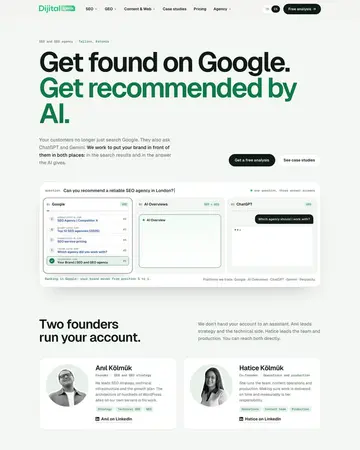

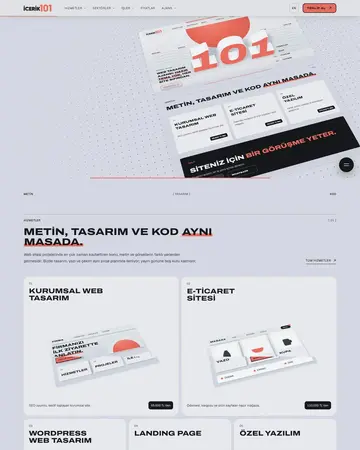
Floor 03 · Grow
AI visibility tracking. Are you in the answer?
AI visibility tracking records how often ChatGPT, Perplexity, Gemini and Google AI Overviews bring up your brand, and link to your pages, when buyers ask about your field. yop tracks AI visibility from Tallinn on a fixed set of real buyer questions in eight languages, compares you with competitors and fixes the pages that should be cited.

AI visibility
What does AI visibility tracking measure?
AI visibility tracking runs the same set of questions through AI assistants on a schedule and records what comes back: whether your brand is mentioned, in what position, with what description, and which pages are cited as sources. Over time it shows whether you are gaining or losing ground in AI answers, the way rank tracking does for Google.
The same prompt can give a different answer each time, so one test proves little. Tracking uses many questions, repeated runs and the same settings each month, and reports trends instead of one-off screenshots.
- Mentions. How often buyer questions get answers that include your brand.
- Citations. Which of your pages are linked as sources, and how often.
- Share of voice. Your mentions set against your competitors’ on an identical question list.
- Accuracy. Whether the facts assistants state about you are correct.
Try it
Ask once, and you know nothing.
Ask the same question twice and the answer may change. That is why we repeat each question and report a share, not a screenshot.
Illustration with invented names. In real tracking each question runs several times on every engine, every month.
- Your Brand
- Rival A
- Rival B
0of 1 run
12345Run 1: you are not named. A one-off check would stop here.
What we track
Six measures, one monthly report.

Prompt set
Real questions buyers ask, built from search data, sales calls and reviews, grouped by topic and buying stage.
Engines
ChatGPT, Perplexity, Gemini, Copilot and Google AI Overviews, tested monthly under identical settings.
Competitor benchmark
Your share of mentions and citations next to the brands you compete with.
Cited sources
The pages, directories and articles assistants cite for your topics, so you know where to be mentioned.
Fact check
Wrong prices, old addresses or outdated descriptions flagged and traced to their source.
Fixes
Pages rewritten answer-first, schema added and facts aligned, so the next run can cite you.
Self-check
Should you be tracking this?
Tick what sounds like your company. Two or more is usually reason enough to measure instead of guessing.
0/ 6
Nothing ticked yet.
One sign: run your top three buyer questions through two assistants this week.
A pattern. Time to measure it rather than guess.
Others are taking answers that could be yours. Start with a baseline across every engine.
How it runs
Four steps into the answers.
Prompt set
Forty to a hundred buyer questions agreed with you, for each language and market.
Baseline
First runs across all engines, with competitors, cited sources and wrong facts recorded.
Fix
Pages, schema and profiles changed where the gaps are.
Track
Monthly runs and a report on mentions, citations and share of voice.
Every month
The files you receive.
Each month’s run ends in four files. They stay yours, so the history is never lost if the work moves to another team.
The monthly report
Mentions, citations and share of voice per topic and engine, with what changed since last month.
Every answer
The full text of each answer we collected, with its date, engine, language and the sources it cited.
The benchmark
You next to your competitors, question by question, so you see who wins which topic.
The fix list
The pages, profiles and third-party sites to change first, and why.
Compare
A tracking tool or tracking with fixes?

| AI visibility tracking by yop compared with a tracking tool on its own | AI visibility tracking by yopOur pick | A tracking tool on its own |
|---|---|---|
| Mentions and citations measured | Yes | Yes |
| Prompt set built from your buyers | Yes | You build it |
| Several languages | Eight | Often English only |
| Explains why you are missing | Yes | No |
| Fixes the pages | Yes | No |
Pricing
What decides the monthly fee.
Tracking is a fixed monthly fee, agreed with the prompt set. Six things set its size.
Number of questions
Forty questions for one product line is a small set; several hundred across many lines is a large one.
Languages and markets
The same question in German and in Finnish counts twice, with two sets of answers to read.
Engines
Each assistant we add is another full round of runs every month.
Runs per question
More repeats give steadier numbers, and more answers to log.
Competitors in the benchmark
Adding rivals costs little; reading the sources they win with takes longer.
Fix work
Tracking on its own, or tracking plus the page and profile changes it points to.
AI visibility and SEO
Where does AI visibility differ from SEO?
SEO measures where your pages rank in a list of links. AI visibility measures whether an assistant names you in a written answer, and which sources it trusts for that answer. The two overlap, because assistants often draw on pages that rank well, but not completely: a well-ranked page that buries its answer may be skipped, while a clear page on a trusted third-party site may be quoted instead.
That is why tracking alone isn’t enough. The report leads straight to work on your own pages and on the sites assistants cite, which is what our AI SEO and digital PR services do.
SEO measures where your pages rank in a list of links.
Your visibility
Ask us one question your buyers ask.
We run it through the main assistants and reply within two working days with who they name, and why.
- From
- you@your-company.com
- To

 Anıl or Hatice
- Send
- We run it through the main assistants and reply within two working days with who they name, and why.
- Reply
- Within two working days
Questions
Asked about AI visibility.
What does AI visibility tracking measure?

What does AI visibility tracking measure?
AI visibility tracking measures how often AI assistants mention a brand and cite its pages when answering a fixed set of buyer questions, tracked over time and compared with competitors.
Which AI platforms do you track?
ChatGPT, Perplexity, Google Gemini, Microsoft Copilot and Google AI Overviews. Others can be added when your buyers use them.
How does AI visibility tracking work?
We agree a set of real buyer questions, run them through each assistant with the same settings every month, and record mentions, positions, cited sources and the facts stated about you.
Can we do this ourselves with a tool?
Yes, tools can collect the data. What they don’t do is choose the right questions, explain why you are missing and change the pages. yop does all three.
How long until AI visibility improves?
Edits to your own pages can appear within weeks in assistants that browse the web live. Being mentioned more widely builds over months, as third-party sites cover you.
Can you track AI answers in other languages?
Yes. We run prompts in English, Turkish, Estonian, German, Finnish, French, Spanish and Arabic, since assistants often recommend different brands from one language to the next.
How much does AI visibility tracking cost?
yop charges a fixed price for the prompt set and baseline, then a fixed monthly fee for tracking and reporting, agreed in advance.
Floor 03 · Grow
More on the Grow floor
Found on Google, named by ChatGPT and the other assistants.
Technical fixes, content and links that lift you on Google.
Your name in the answers ChatGPT, Gemini and Perplexity give.
Crawling, indexing and speed fixed at the source.
What holds your site back, ranked by what it costs you.
Found on the map when people search nearby.
Categories and products that rank and sell.