
Floor 01 · Build
Custom software development.
Custom software development is writing software that follows the way your company already works, so your team stops bending its process around tools designed for someone else. yop is a custom software development company in Tallinn: we design, code and ship it, and the code, the data and the accounts stay in your name.

What we build
Built from an empty file.
- Order 41Packed
- Order 42Paid
- Order 43Sent
SaaS products
Subscription products with accounts, plans and payments, built to carry thousands of customers on one codebase.
Internal tools
The order screen, the approval flow, the weekly report: work your team now does by hand across five tabs.
MVPs
The smallest real product that answers the one question your investors keep asking.
Follow one order
Same order, three ways to run it.
Send one order from quote to invoice. Switch the tool underneath and watch where the copying and the waiting go.
Illustration of a typical order flow, not a client’s data.
- 01QuoteEmail
- 02ApproveSheet: quotes
- 03ProducePhone call
- 04DeliverSheet: trucks
- 05InvoiceAccounting
4 tools open, the order typed 4 times
What we build most
Products and tools, made to order.
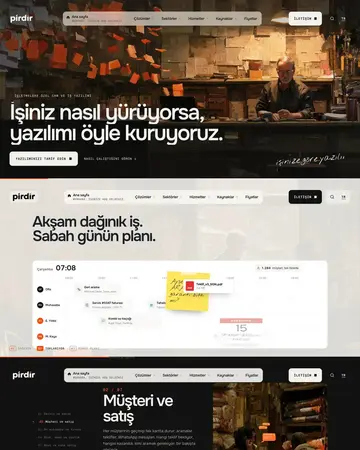
Business systems such as CRM, ERP, stock and dealer ordering are built by our sister company pirdir on its own ready-made core.
Booking and membership platforms
Bookings, memberships and payments for clinics, studios, schools and clubs, with the admin side your staff runs every day.
Marketplaces and communities
Profiles, listings, messages and payouts on one platform, from the first city to the next country.
Dashboards and admin panels
Your numbers on one screen and the buttons that change them next to it, with roles and a log of every change.
AI inside the product
Chat, search and document reading built into your software, on the model that suits each task.
Products in eight languages
Screens, emails and help pages in every language you sell in, right-to-left layouts included.
Rebuilds and rescues
An old product or a stalled project reviewed, taken over and rebuilt in stages, while the business keeps running on it.
Before you decide
Three beliefs that cost companies a year.
We often hear
“Custom software takes years.”
What we see
A narrow tool that replaces one painful routine can be live in weeks. Big systems are built the same way: one working piece at a time, each in use before the next starts.
We often hear
“We need every feature at launch.”
What we see
Launch with the steps people do every day. The rarely used ones wait until the team has worked with the first version and knows what it actually misses.
We often hear
“We will be stuck with the agency forever.”
What we see
Only if the code and accounts are theirs. Ours sit in your name from the first day, with documentation another team can pick up.
Build or buy?
Five questions, one honest answer.
Answer five questions. If an off-the-shelf tool fits, we will say so.
01Does your process differ from how most companies in your field work?
02Will more than 20 people use it every day?
03Do you need it to talk to systems you already have?
04Is the software itself part of what you sell?
05Do you need to own the code and data?
0 of 5 answered
Answer the questions to see a recommendation.
Buy. A ready-made tool will probably serve you well. Describe how you work and we will name the tool we would pick.
Mix. Keep a ready-made tool for the routine and let us build the one piece your competitors do not have.
Build. Your case fits custom software. The next step is a discovery workshop.
Compare
Custom or off-the-shelf?

| QuestionQuestion | Custom softwareOur pick | Off-the-shelf |
|---|---|---|
| Does it fit your process? | Built around it | You adapt to it |
| Who owns it? | You own the code and the data | You rent a license |
| Upfront cost | Higher | Lower |
| Cost as you grow | Mostly hosting and upkeep | Rises with every seat |
| Time to start | Weeks | Days |
| Connections to other systems | Any system with an API | What the vendor supports |
Cost
What moves the price.
After a short discovery, each phase gets its own price. Here is what moves the number the most.
Integrations
Each outside system adds mapping, testing and error handling. Old systems without an API add the most.
User roles
Every extra role brings its own screens, permissions and the tests that prove nobody sees too much.
Moving old data
Years of spreadsheets have duplicates and gaps. Cleaning them before import is often a project of its own.
Design depth
A clean internal tool needs fewer custom screens than a product your customers pay for.
Offline and mobile
Work that must continue without signal, or on a phone in the field, needs its own sync logic.
Rules and approvals
Discount limits, sign-offs and audit trails are cheap to sketch and slow to get exactly right.
How it works
Five doors to launch.
Discover
One workshop to map the problem, the users and what success looks like.
Design
Clickable screens before code, so changing your mind stays cheap.
Build
Short cycles, a live staging link and a demo every week.
Launch
Production, monitoring and the keys handed over to you.
Grow
SEO, GEO and new features, if you want us to stay.
A typical start
The first month, week by week.
How the first weeks usually run on a narrow internal tool. Larger systems repeat the same rhythm for each piece.
Day 1
Workshop
A half day spent with the people who actually do the work. We leave with the problem, the users and one measure of success.
Week 1
Clickable screens
The core screens on a link your team can click through, changed the same day they disagree.
Week 2–3
First build
The main flow working on a staging link, with your real fields and a weekly demo.
Day 30
In use
A small group runs real work through it. Their notes decide what the second phase builds.
Your software
Start with one workshop.
In one session we sort out the problem, who will use the tool and how you will know it works. Building comes after, only if it makes sense.
- From
- you@your-company.com
- To

 Anıl or Hatice
- Send
- In one session we sort out the problem, who will use the tool and how you will know it works.
- Reply
- Within two working days
Questions
Asked before every project.
How much does custom software cost?
How much does custom software cost?
It depends on scope. We price after a short discovery, as a fixed price per phase, so you never sign an open-ended contract.
Who owns the code?
You. We open the Git repository and the hosting under your company on day one and work inside them as guests.
Can you work with our own developers?
Yes. We often build the first version and then hand it over to an in-house team with documentation and pairing sessions.
How fast can yop deliver custom software?
A narrow internal tool is often live within weeks, while a full product runs for months. Discovery ends with a phase-by-phase calendar, and from then on a new build lands on your staging link each week.
What is custom software development?
It is designing and building software for one company’s own process or product, instead of buying a ready-made tool and adapting to it. The company owns the result and can change it whenever the business changes.
Is custom software worth it for a small company?
Often, when a small team loses hours every week copying data between tools, or pays for many seats of a tool that barely fits. When an existing product covers the process with small changes, buy it. The five-question check on this page helps you decide.
What happens after launch?
You choose: a monthly care plan with fixes, updates and new features, or a handover to your own developers with documentation and pairing sessions. Either way, the code and accounts are already yours.
Floor 01 · Build
More on the Build floor
Custom software, SaaS, apps and AI, owned by your company.
Subscription products with accounts, plans and billing.
The smallest real product that paying users can try.
iOS and Android apps people keep on their home screen.
The numbers and screens your team opens every morning.
Back office, genealogy and commissions, built for your plan.
AI and automation inside the tools you already use.
Your website, apps and services talking to each other.